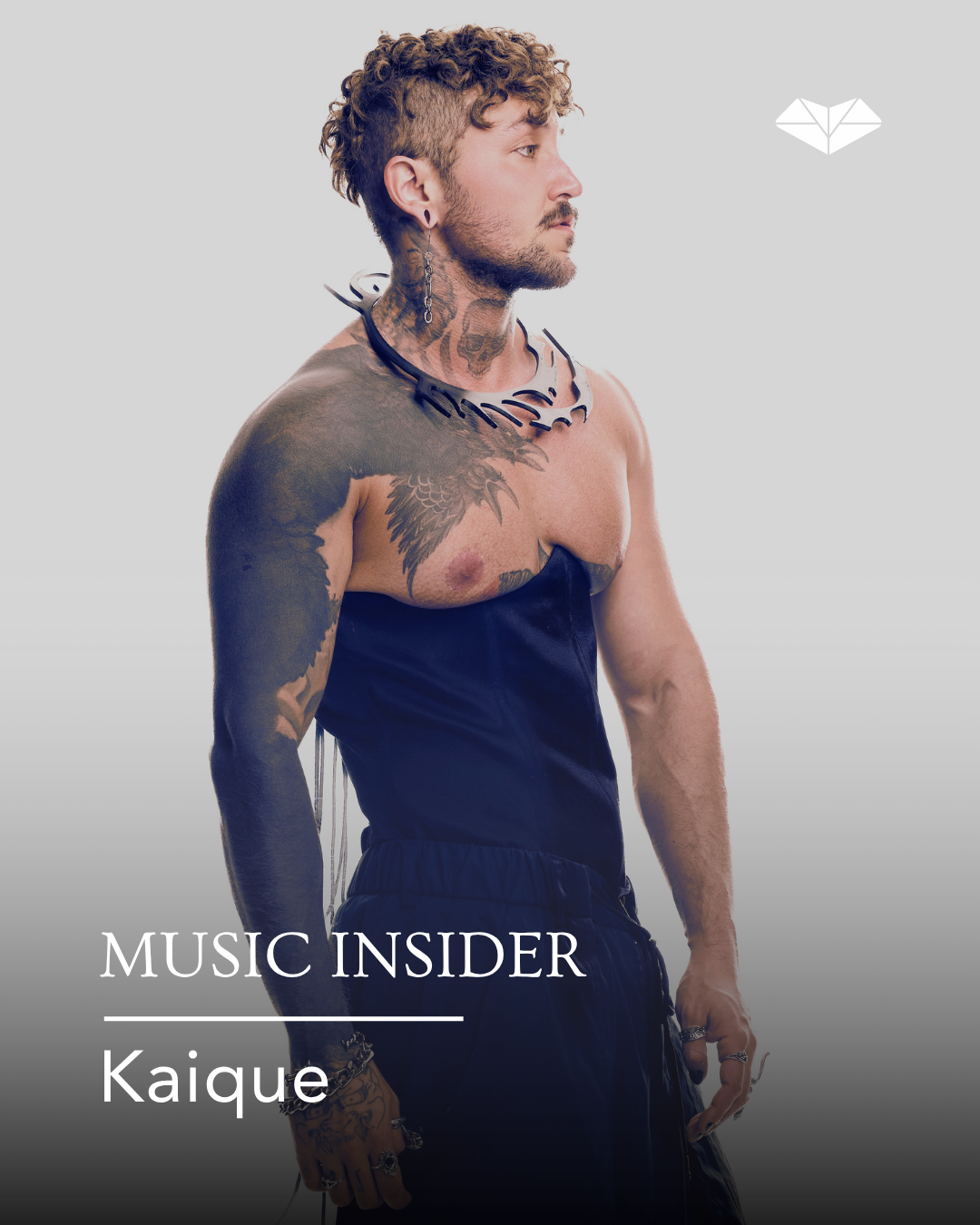
Kaique is a Brazilian singer, songwriter, actor and model pushing the boundaries of Brazil's contemporary R&B, trap and Nova MPB scenes. Working under the artistic identity A Corte (The Court), he has built a distinctive creative universe rooted in what he describes as "Tropical Noir" and "Trash-Luxury" aesthetics, where raw urban realities meet cinematic elegance.
As a transmasculine artist, Kaique brings a bold and uncompromising perspective to Brazilian music, blending transfuturist ideas, visual storytelling, fashion and sound into a multidisciplinary practice that challenges conventions while imagining new possibilities. Following the release of his conceptual debut album Me Chame Pelo Meu Nome, he continues to expand the world of A Corte through new music, including recent single Marola, while developing his forthcoming project TRANS/A.
Your work blends music, visuals and fashion into a very distinct world. How would you describe the universe of A Corte in your own words?
I often say I’m just another person trying to build a universe where existence is actually possible. I lean heavily into **transfuturism** as a foundational lens to reimagine and reinvent the future through music and visuals. This extends behind the scenes too, at least 80% of my team is queer, which brings essential layers, references, and lived experience to the work.
Everything communicates, even silence. ACORT3 is a vessel for those screams to echo, but also for silence to remain when needed. It’s the signature of an artist who is tired, yet anxious to truly live in a better world.
Visual storytelling feels like a huge part of your work, from VHS textures to grunge-inspired aesthetics. What inspires your visual direction?
I’m a 90s kid, so I drink deeply from the MTV era and that specific, gritty atmosphere it had. I’m drawn to saturated colors, VHS textures, and grunge aesthetics because they feel honest. For me, visual storytelling isn't about polish; it's about capturing a raw, nostalgic distortion that mirrors the transfuturist themes in my music. It’s a way to visually translate the tension between the past we inherited and the future we’re trying to write.

Since it’s Pride Month, what does Pride mean to you right now as both an artist and a trans person creating in Brazil?
Right now, as a trans artist creating in Brazil, Pride means **resilience in its rawest form**. We are facing unprecedented censorship online, and offline the reality is just as stark.
I’ll be performing at the São Paulo Pride Parade this year, which ironically received almost zero public funding despite being one of the largest in the world. We are truly living in a guerrilla era here lol creating, occupying, and resisting with whatever we have.
Have there been moments where you felt you had to create your own space rather than wait for the industry to make room for you?
So yes, I stopped waiting for the industry or institutions to make room a long time ago. Building a team that is 80% queer wasn't just a hiring choice; it was a survival strategy.
We built our own ecosystem because the existing structures weren't designed for us, and in this guerrilla context, community isn’t just about belonging—it’s about mutual protection and keeping the culture alive against the odds.
You were selected for the Ballantine’s True Music Fund powered by shesaid.so in 2025. What attracted you to the programme, and what has the experience been?
Honestly, this fund was the key that unlocked a dream I’d been guarding for years. My debut album had been sitting in the drawer… not because of a lack of vision, but because of a lack of possibility. The True Music Fund didn’t just offer support; it offered **viability**.
What attracted me was that they saw the value in an artist whose work exists at the intersection of music, trans identity, and visual world-building, without asking me to dilute any of it. The experience has been transformative: it turned a 'someday' project into a tangible reality, allowing me to finally release my first album with the integrity and production quality it always deserved.
What are you focused on creatively at the moment? What can you tell us about this current phase of your work?
I’m currently producing my next album, trans/a, which features tracks in English, Spanish, and Portuguese. This trilingual approach is a deliberate expansion toward the international market, with a specific focus on Latin America.
Creatively, this phase is about dissolving linguistic borders while deepening the transfuturist narrative. I’m exploring how different languages carry distinct emotional textures and cultural codes, allowing the universe of ACORT3 to resonate across territories without losing its core identity.
It’s not just translation; it’s about building a sonic ecosystem where the message adapts but the essence remains intact.
Networking can feel intimidating for many emerging artists. What’s one thing that has genuinely helped you build connections and community?
Radical authenticity over strategic networking. I stopped trying to ‘network’ in the corporate sense and started building kinship. When you’re unapologetically yourself and transparent about your vision, you attract collaborators who resonate with the frequency, not just the opportunity.
My core team grew organically because we share the same urgencies. Genuine community in this space comes from mutual protection and shared references, not business cards.
What are you listening to the most right now — any artists, albums or sounds constantly on repeat?
Hell yea: Villano Antillano, Kali Uchis, Liniker, Julia Costa, Kaytranada, Sade, some jazz music and some punk folks screaming at my head sometimes.
Outside of music, what’s currently inspiring you creatively — films, fashion, books, internet culture, everyday life?
I’m deeply inspired by curiosity itself. Lately, I’ve been getting lost in classic literature like Baudelaire, and I’m passionate about philosophy, especially when it intersects with our current political reality.
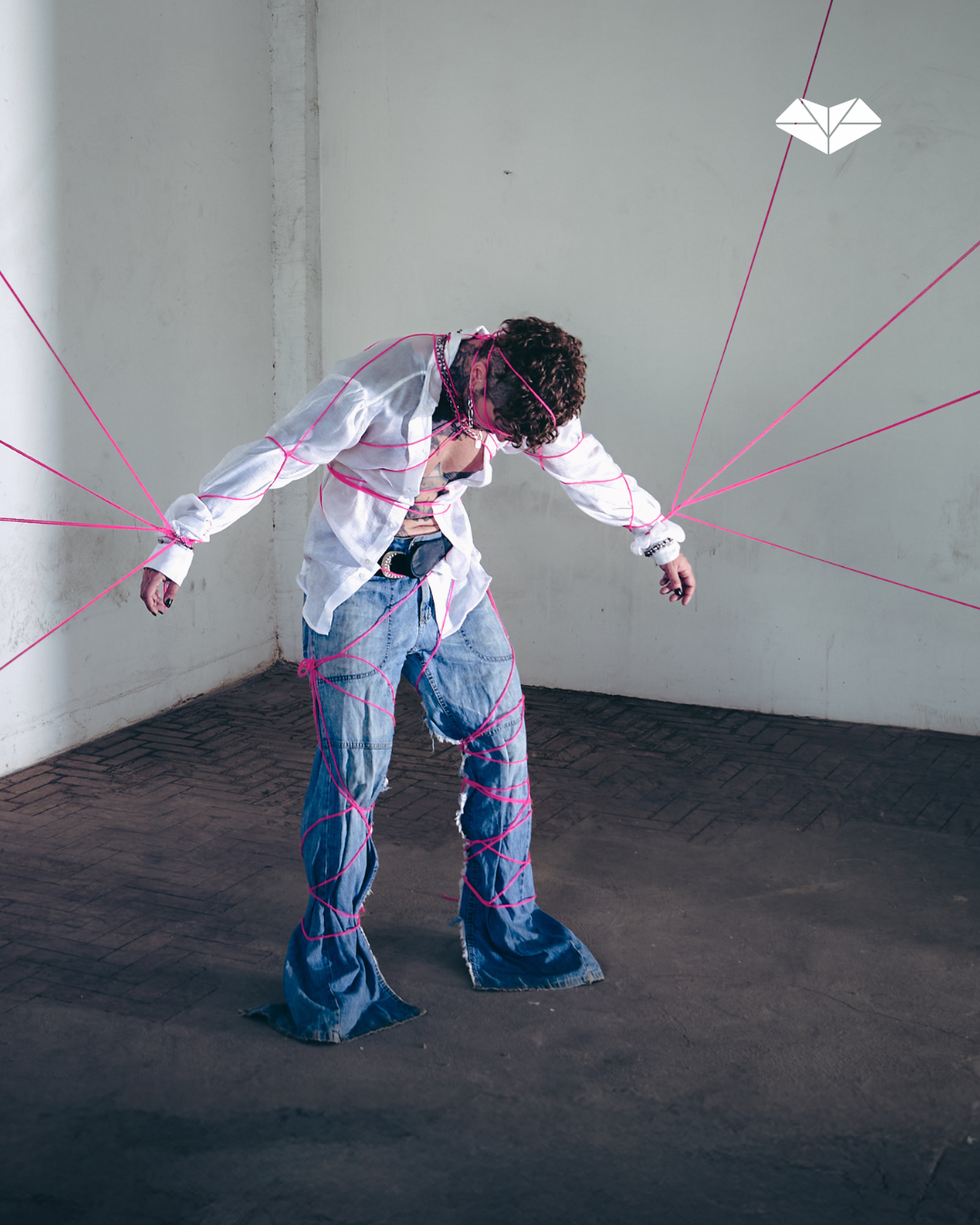
Fashion is another huge pillar for me, particularly sustainable fashion and that unbeatable mix of tailoring with streetwear: layers upon layers of fabric, structured silhouettes meeting raw, urban textures.
These elements aren’t separate from my music; they’re part of the same transfuturist language. The way Baudelaire wrote about modernity and decay, the way philosophy dissects power, the way layered fabrics protect and reveal, it all feeds the universe of ACORT3.
Creativity, for me, doesn’t live in one medium; it’s a continuous dialogue between text, cloth, politics, and sound.