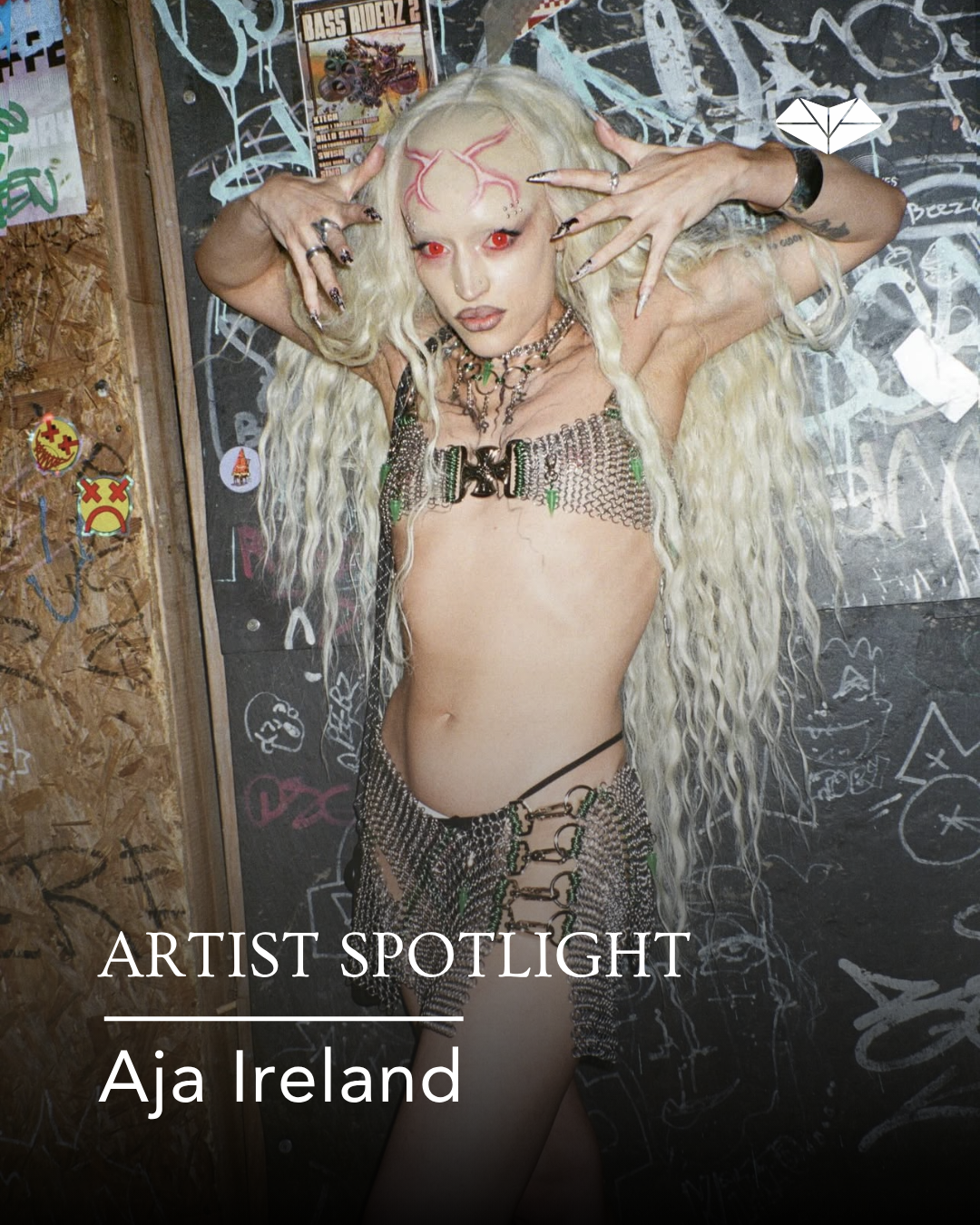
Photo Credit Hogg: IG @999999999boyscrysendpics
Aja Ireland is a multidisciplinary electronic artist working across performance, sound design, visuals, DJing and creative development. Her work spans club, gallery and digital environments, with a focus on live performance, spatial sound and collaborative visual worlds.
Her latest project, Moult Mouth, is an EP and live AV show released across February to April 2026. Blending experimental UK bass, industrial techno, baile funk percussion and detailed sound design, the record is built alongside a physical performance practice where movement plays a central role. Developed in collaboration with Joey Holder, the project extends into a multidisciplinary audiovisual work incorporating costume, choreography and digital visuals.
Across both the EP and the live show, the human form is continuously altered and reconfigured. Costumes by Studio FCLX and SKNDLSS exaggerate and distort the body, while the visual world introduces shifting, hybrid organisms and unstable physical states. Sound and image operate together to create an immersive environment that moves between club energy and performative intensity.
Movement functions as a core element within the work. Ireland approaches dance as a form of expression and construction, shaping both the performance and the way the music is realised. The result is a project that connects sound, body and image within a single framework, presented through both recorded material and live performance.
What follows is a conversation with Ireland on the development of Moult Mouth, her approach to collaboration, and the processes that inform her work across sound, movement and visual form.
Moult Mouth explores monstrous femininity, body autonomy and liberation through movement and sound. What drew you to the “monstrous” as a creative and emotional framework for this project?
Growing up as a woman in club spaces, you quickly learn that your sensuality isn't really yours. Men touching you, staring at you, your body existing to satisfy someone else's gaze. That's just a normal Tuesday night out for most women, and it makes it genuinely confusing to figure out how to have sexual and sensual energy and actually celebrate it in a healthy way. Nobody really teaches you that part.
Queer safe spaces changed that for me. Good music, a place to dress up, people who weren't watching to consume you. That's where I started to find and celebrate that side of myself.
The monstrous aesthetic is two things for me running alongside each other. The first is that I genuinely find it beautiful. Leigh Bowery, Hungry, Matières Fécales have been with me from the start, and more recently Niohuru X, who really leans into it. What people are calling post-human beauty now, distorted drag, contradictions and contrasts, that space has always felt like home.
What I love about it is that it lets the usually hidden things exist openly without needing to be fixed. Discomfort, imperfection, the parts of yourself that don't feel easy to show. It's like meeting your shadow self instead of pushing it away, recognising something in those warped, unfamiliar forms that reflects your own inner contradictions. Beauty stops being about becoming acceptable and starts being about letting everything be seen, even the parts you'd rather deny.
The second part is more personal. When I'm dressed like that, I can actually move the way I want to. The monstrous aesthetic acts as armour. Somehow it gives me permission to be sensual in a way that feels safe and entirely mine. So Moult Mouth was expressing the frustrations with the (like in the track Smile) but also celebrating moving through it (like with Mami Voguer and Grind it like).
The EP exists not only as music but as a multidisciplinary work spanning AV performance, costume and visual worlds with Joey Holder. How do you approach building a cohesive artistic universe across sound, body and image?
Joey and I have been collaborating for nearly ten years, so there's a real shorthand there. Our interests, references and instincts have a lot of crossover, and working together feels completely natural as a result.
In terms of how a project like Moult Mouth comes together, it's honestly less about planning and more about accumulation. I'm always collecting, always drip-feeding myself new inspiration. Then because of my ADHD, there'll be a burst, usually three to six months where I'm so fired up I just have to make something. With this EP, I was touring Cryptid, still producing constantly on the road, and this whole new body of work arrived.
The cohesion comes from staying true to a set of obsessions that have been with me my whole career: distorted drag, creaturely beauty, the monstrous as expression. It's never a decision, it's just where everything naturally lands.
Your live shows are intensely physical and performative. How has incorporating movement and embodiment changed the way you produce or structure your music in the studio?
Movement is an expression of the music I produce, and I always produce from a place of pure inspiration. Mami Voguer came directly from playing Dancity Festival and being so inspired by the other artists that I just had to make a song to represent what I'd just experienced.
Smile was made after playing with Slikbak at Avant Art Festival. Other artists inspire what I'm making, but the ones that affect me most are always the ones that make me move my body. It's almost like I'm detached from it, it does things I couldn't think of by myself.
Whilst making Moult Mouth, I was on my own journey of just wanting to move in a more sensual way and not feel self conscious doing it. There was a real block there, an insecurity.
So everything is created and expressed in flow state. In terms of specific production choices, I used more Brazilian percussion on the record, and structured the first few tracks in a more commercial way, with choruses and verses, which isn't something I always do but I felt they needed that structure. Then the techno tracks towards the end of the record were much more free flowing.
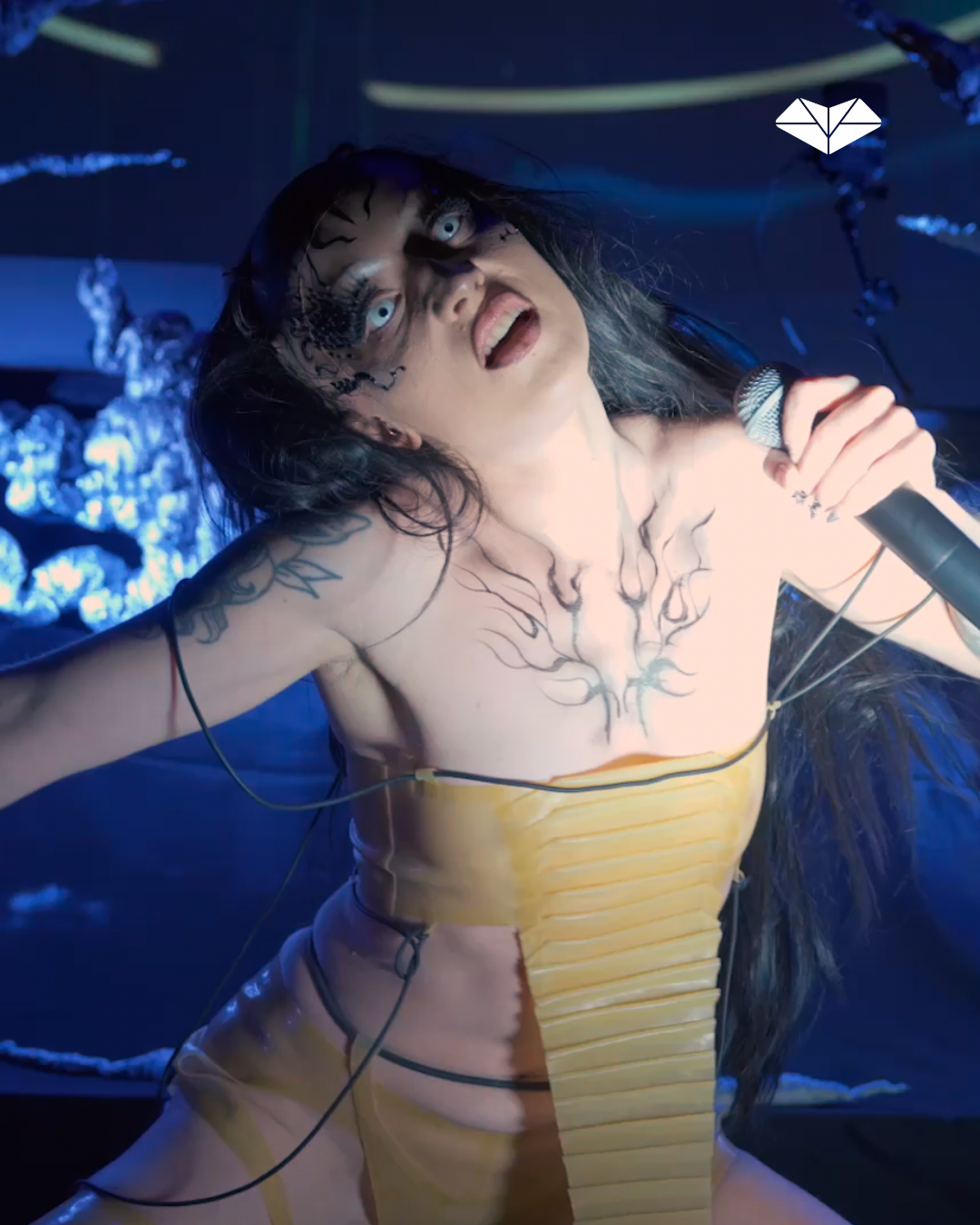
Photo Credit: Nanni Roberto
What is your favourite part of the music-making process, and what is the part you find most challenging or confronting?
When I'm at my most inspired I feel like a vessel and it just flows through me. I could make music for hours, days, without eating or sleeping or taking breaks.
The most challenging part is that I never feel like I reach what I actually want to sound like. And I change genre a lot, so when people connect with a particular track or sound I'll often completely change direction on the next record.
The WORM residency really reminded me why I make sound in the first place. Being fully immersed in a studio for days shifts something in how you think. Instead of chasing ideas they just start happening, textures unfolding, rhythms building, machines responding in ways you didn't expect.
Some of the best moments weren't about finding the perfect sound but letting the machines lead, responding instinctively rather than overthinking. I was drawn to the unpredictable, the way certain synths seem to breathe when pushed a certain way, how layering raw unprocessed sounds creates something deeply alien. The Synton Syrinx, only a few hundred were ever made between 1983 and 1984, the Emotional Machine by Dalin Waldo, the Blippoo Box by Rob Hordijk, the Roland D50. Every instrument had its own logic and I had to meet it on its terms.
That instinctive approach is how I work generally. I love to layer and manipulate sounds without listening back in between, just building blindly and discovering what's happened. I use Granulator a lot, autotune in places it's not supposed to be, I resample constantly.
You’ve built a career across club culture, contemporary art, film and performance contexts. What helps you connect with the right collaborators and creative communities?
It's one thing to love someone's work, and for them to love yours, but you also have to connect on a level of energy and communication, both need the time and capacity, and there are so many things that have to align for a collaboration to actually work.
A lot of it I think is down to my higher power and who she wants me to work with. But social media is a genuinely useful tool for research and connection, and so is paying attention to what friends and peers are sharing, going to events, being on tour. I don't really go out unless I'm playing these days, but there are always so many inspiring artists to discover.
You have to listen to your gut. Just because you love someone's work doesn't mean it's going to be a good fit. I think you just know when you meet the right person. I’ve loved collaborating with Joey Holder, LULALOOP, IMPATV and BORA over the years and in the last year am so grateful for new collaboration with Nicholas Delap who created the music video for Mami Vogue and to Studio FCLX and SKNDLSS for the costumes for touring and music videos which have been an absolute dream. I love to be positive and show as much respect and gratitude as possible when working with other people and have built such beautiful relationships and long term friendships from this.
What practical advice would you give to artists trying to develop a distinctive artistic identity and creative voice?
I've taught this to a lot of students and musicians over the years, and there's so much I could say, but I keep coming back to three things.
Be authentic. Stay true to what really moves you and what is right for the project.
Have anchor points. Key influences, people, images, anything from a record cover to a make-up artist to something like water or nature. Choose a few and keep returning to them, especially during creative blocks.
Do your research properly. Not just who and what is currently trending, but go back in time and understand who they were inspired by. Read books. Don't just build a Pinterest board, although those are genuinely useful too.
I do 1:1 sessions and workshops teaching this so make sure to follow me on IG for updates @ajaireland or drop me an email if you’d like more support with this musicwithaja@gmail.com
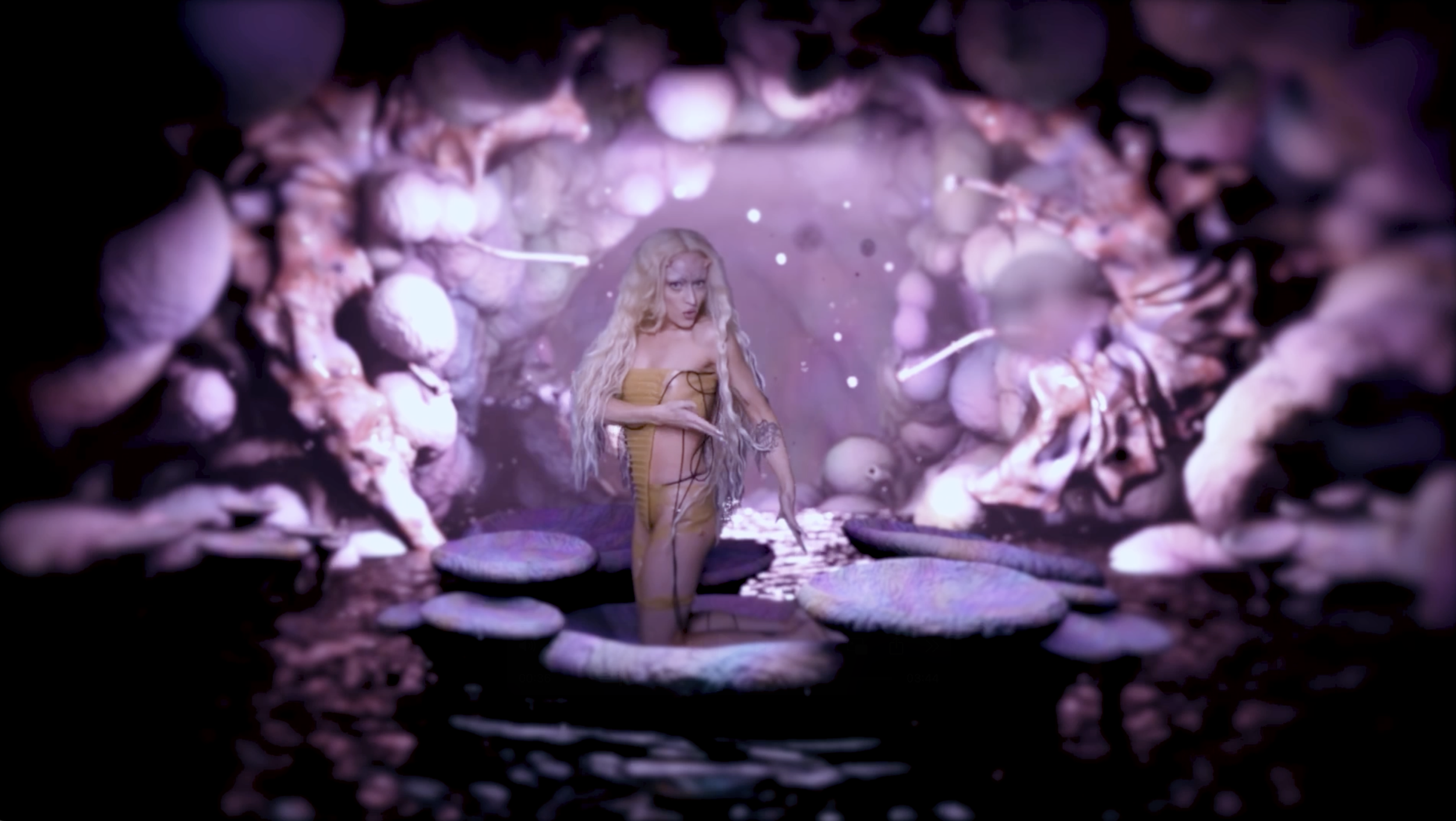
Mami Voguer Still
How do you stay creatively grounded or take care of yourself during intense creative periods or touring?
To be honest, the time I need to take most care of myself is actually during the booking period. There is so much rejection that comes with pitching shows, and that's what I struggle with most. The touring itself is the fun part, even if it's physically demanding.
When I'm on the road I make sure I do really thorough logistics planning so everything runs smoothly and I'm not carrying that mental load as I do all the bookings myself. Generally I have to do a lot of self care anyway in my life. I meditate, I'm sober, nearly nine years now, and I try to eat well and exercise. It all sounds very boring but the most basic things have the biggest impact. I also reach out to friends and fellow musicians for support, because doing everything yourself is a lot. And I do take proper breaks. Every few years I might take a year out, get a normal job for a while, have the same routine and feel grounded again.
What tools, techniques or approaches have been most important in shaping your sonic language?
Experimentation above everything. I use Ableton, I love Granulator, I use autotune in places it's not supposed to be used, and I resample constantly.
I love to draw my compositions out using shapes and symbols before I start, to plan the journey of the track. I also love to layer and manipulate sounds without actually listening back in between, just stacking plug ins, warping, stretching, reversing, tweaking parameters completely blind, and then discovering what's happened.
Recent plug ins I've been enjoying include Random, and I'm currently doing a course with Arca where I noticed she also loves Synplant, which I've been exploring. I had some lessons with Randomer last year too.
Generally I love polyrhythms, deconstructed club and experimental techno, and more recently I've been bringing in Brazilian percussion, which I've always loved but never really knew how to use properly until now. I pull raw samples from Splice, build in Drum Rack, and love generating random patterns as a starting point.
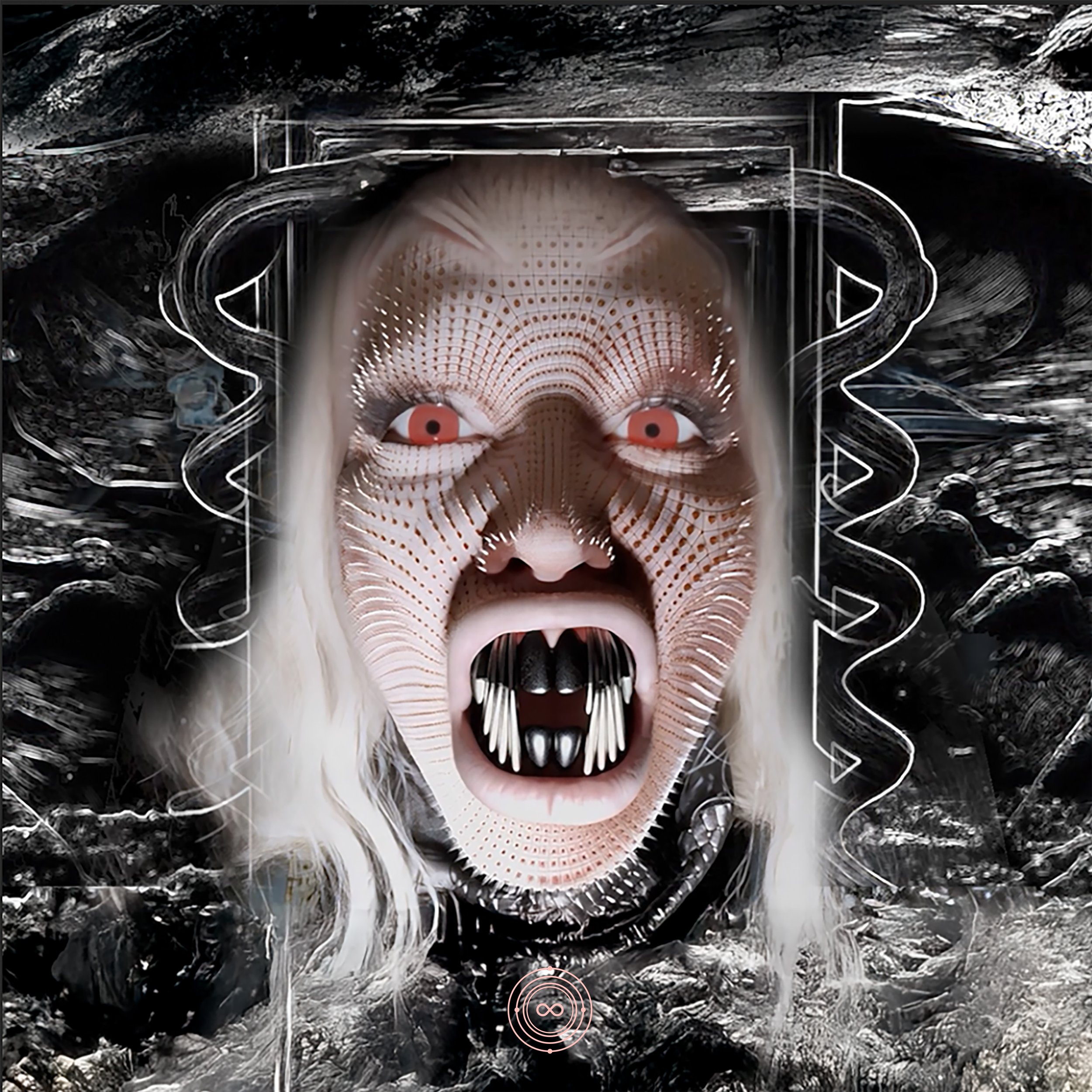
Live I use a Roland TR8S, an autotune pedal with distortion and delay on vocals, and I run the drums through a Metal Zone. I used to use a Korg Minilogue live but after so much international touring I had to reduce the setup, so now it's Ableton and a midi controller to trigger samples alongside the drum machine (although I hate using a computer on stage haha).
Looking back at your journey so far, what is something you wish you had known when you first started as a producer and performer?
I might have studied music if I'd known how much connections matter in this industry. Not really for the learning itself, but for the access. Getting in front of the right people is genuinely hard when you can't afford to live in London and you're not interested in the drinking and going out side of things. But really I wouldn’t have changed anything - I think everything happens for a reason, and we are exactly where we’re supposed to be. There is a lesson in all the difficulties and it builds strength and empathy.